

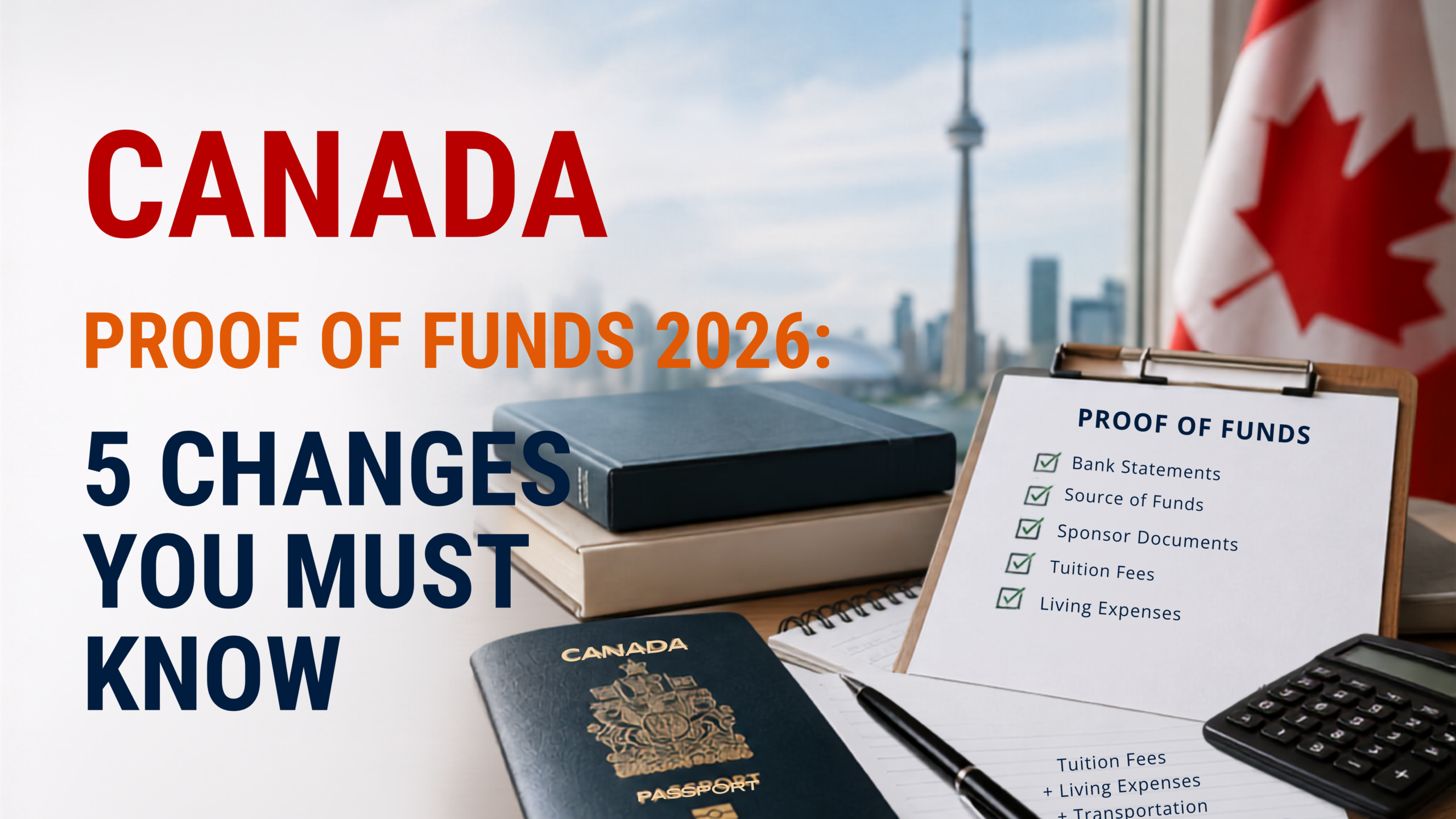

If you’re a Nigerian student planning to study in Canada, there is an important update you need to understand before submitting your study permit application. Canada proof of funds 2026 requirements now put greater emphasis on where your money came from, not just how much is sitting in your bank account.
On July 24, 2026, Immigration, Refugees and Citizenship Canada (IRCC) updated its instructions for officers assessing study permit applications. The update changes how financial evidence is assessed, including the source of funds, the financial history officers review, and the types of income that can be used to support an application.
The amount of money you need has not increased because of this update. What has changed is the level of attention your financial history may receive. If you are preparing your Canada study permit application, here are the five changes you need to know.
Canada Proof of Funds 2026: What Changed?
The July 2026 update focuses heavily on the financial story behind an application. In simple terms, having enough money in your account is important, but you also need to be able to demonstrate where that money came from and why you have access to it.
The five key changes are:
- IRCC is placing greater emphasis on the source of funds.
- Updated officer instructions refer to six months of bank statements.
- Rental income and pension income are now specifically included as examples of financial documentation.
- Convertible bank drafts have been removed from the examples in the officer instructions.
- Financial capacity for study permit extensions is now assessed based on the first year following the extension.
Let’s look at each change and what it means for your application.
1. IRCC Wants to Know the Source of Your Funds
This is arguably the most important change in the Canada proof of funds 2026 update. IRCC’s updated officer instructions make it clear that the source of funds should be assessed in all cases.
That means your application should not simply answer: “How much money does the student have?”
It should also answer: “Where did the money come from?”
For example, if you have a large balance in your account shortly before applying, an officer may want to understand how that money was accumulated.
Was it:
- Salary income?
- Business income?
- Rental income?
- A parent’s savings?
- An education loan?
- A scholarship?
- Proceeds from the sale of property?
- A transfer from another family member?
The source matters because your financial documents should tell a consistent story. A bank statement showing a large balance on its own may not tell the whole story.
What This Means for Nigerian Students
This is particularly relevant if your parents or another family member are paying for your studies. If your father is sponsoring your education, for example, your application should explain how he earned or accumulated the funds used to support you.
If your family runs a business, business and income documentation may help establish the source of the money. If the money came from property or rental income, documents supporting that income can help explain the deposits. The goal is not to make your finances complicated. The goal is to make them understandable and credible.
2. Six Months of Financial History Is Now Important
Another significant part of the Canada proof of funds 2026 update is the financial history officers are instructed to review. The updated officer instructions refer to six months of bank statements, including the month of application or the month immediately before it. This is an important change from the previous four-month reference in the officer guidance.
However, there is an important detail applicants should understand. IRCC’s public proof-of-financial-support webpage has continued to list four months of bank statements as common. For example, updated officer instructions and some country-specific document checklists refer to 6 months. So don’t build your application around finding the shortest possible statement period.
If you are preparing a Canadian study permit application, particularly from Nigeria, it is sensible to prepare a clear six-month financial history and check the current IRCC instructions that apply to your specific application before submitting.
Why Does the Financial History Matter?
A six-month history gives an officer more context than a single account balance. It can show:
- Regular income
- Normal spending patterns
- Large deposits
- Transfers between accounts
- Sudden increases in the balance
- How long the funds have been available
This is why waiting until the last minute to arrange your proof of funds can create unnecessary complications. If you know you intend to study in Canada, start organizing your finances well before your application.
3. Rental and Pension Income Are Now Specifically Recognised
The 2026 update is not entirely about stricter scrutiny. It also adds clarity around certain types of income.
Rental income and pension income are now specifically included as examples of financial documentation in the updated officer instructions. This can be useful for families who use multiple sources of income to support a student’s education.
Using Rental Income as Proof of Funds
If rental income contributes to your financial situation, your documentation should make the source of that income clear. Depending on your circumstances, this could include evidence relating to:
- The property
- The rental arrangement
- Rental payments
- The amount of income received
- The movement of that income into the relevant account
The important thing is that the rental income should connect logically to the money you are presenting as proof of funds.
Using Pension Income as Proof of Funds
Pension income has also been added as an example of financial documentation. This could be relevant when a parent or another sponsor receives pension income and contributes to the student’s education. Again, the objective is to show that the income is legitimate, accessible, and consistent with the overall financial picture.
4. Convertible Bank Drafts Have Been Removed From the Examples
Another change in the updated officer instructions is the removal of convertible bank drafts as an example of proof of funds. This matters if you were planning your financial evidence around a bank draft simply because it appeared in older guidance.
The broader lesson is more important than the document itself. IRCC is placing greater emphasis on financial evidence that allows an officer to understand the history and source of funds, rather than simply confirming that funds are available at the point of application.
So if you are preparing your Canada proof of funds documents, don’t rely on outdated checklists or advice from previous applicants. Always check the current IRCC requirements for your application.
5. Study Permit Extensions Are Also Affected
The 2026 update does not apply only to students applying for their first study permit. It also addresses financial capacity when a student applies to extend their study permit. Under the updated instructions, officers assess financial capacity for the first year following the extension.
If you are already studying in Canada and need to extend your study permit, your financial documents still need to demonstrate that you can support yourself during the relevant period. This means existing students should not assume that proof of funds only matters when they first enter Canada.
How Much Proof of Funds Do You Need for Canada in 2026?
One thing that did not change in the July 2026 update is the living-expense amount. For a single student studying outside Quebec, the current amount is CAD $22,895 for one year of living expenses, in addition to tuition and transportation costs.
So if your first-year tuition is CAD $20,000, for example, you cannot treat CAD $22,895 as the total amount you need to demonstrate. You need to account for:
First-year tuition + living expenses + transportation. The required amount also changes depending on the number of family members accompanying you and whether you are studying in Quebec.
For the latest figures, always check the official Government of Canada requirements before submitting your application.
What Counts as Proof of Funds for a Canada Study Permit?
IRCC provides several examples of documents that can demonstrate financial support. Depending on your situation, these can include:
| Proof of funds | What it can demonstrate |
| Bank statements | Available funds and financial history |
| GIC | Funds available for living expenses |
| Education loan | Access to education financing |
| Scholarship letter | Financial support awarded to the student |
| Sponsor letter | Who is providing financial support |
| Rental income documents | Income generated from property |
| Pension statements | Pension income available to the sponsor or applicant |
| Proof of tuition payment | Tuition already paid |
You do not necessarily need every document on this list. The right combination depends on who is funding your studies and where the money comes from.
What If Your Parents Are Sponsoring You?
Parents can provide financial support for a student’s Canadian study permit application. But if your parents are paying for your education, don’t think of their bank balance as the only document that matters.
You may also need supporting evidence that helps establish:
- Their relationship to you
- Their employment or business
- Their income
- Their financial capacity
- The source of the funds
- Any significant deposits or transfers
For example, if your parent runs a business and suddenly transfers a large amount into your account, the application should be able to explain the transaction. The stronger approach is to prepare the evidence before the money moves, rather than trying to reconstruct the financial story after the fact.
What If There Is a Large Deposit in Your Account?
A large deposit does not automatically mean your study permit application will be refused. The issue is whether the deposit has a legitimate and explainable source. For example:
Property sale:
Keep documentation showing the property transaction and how the proceeds were credited to your account.
Business income:
Keep records that demonstrate the business and the income generated.
Family transfer:
Be able to explain who transferred the money, why they transferred it, and where the money originally came from.
Education loan:
Provide the relevant loan documentation showing the amount and terms.
Don’t simply move money into an account because you need to show a certain balance. Your financial documents should reflect a genuine financial position that you can explain.
What Nigerian Students Should Do Before Applying
If you are planning to study in Canada from Nigeria, don’t wait until your admission is secured and your visa application deadline is approaching before thinking about proof of funds. Start early.
Review your financial history. Look at the accounts you intend to use and understand what an officer would see if they reviewed several months of transactions.
Identify your source of funds. Know exactly where your tuition and living expenses are coming from.
Document your sponsor. If your parents, spouse or another family member is funding you, start gathering the documents that support their income and financial position.
Explain unusual transactions. If there are large deposits, property sales, business transfers or other unusual transactions, keep the documents that explain them.
Don’t manufacture a financial history. Moving money around to make your balance look stronger can raise more questions than it answers.
The aim is to present a genuine, well-documented financial position.
The Biggest Lesson From the Canada Proof of Funds 2026 Update
The biggest takeaway is simple: Don’t just prove that you have the money. Be prepared to prove where it came from. The amount still matters. Your tuition still matters. Your living expenses still matter. But the financial story behind those numbers matters too.
For Nigerian students in particular, this means you should think of proof of funds as more than just a bank statement. It is the combination of your: Bank statements + source of income + sponsor documents + supporting evidence + financial history. When those pieces tell the same story, your application is easier to understand.
How much proof of funds do I need for Canada in 2026? A single student studying outside Quebec currently needs to demonstrate CAD $22,895 in living expenses for one year, in addition to tuition and transportation costs.
Did Canada increase the proof of funds amount in 2026? No. The July 2026 update changed the way financial evidence is assessed, but the living-expense amount was not increased as part of this update.
How many months of bank statements do I need for a Canada study permit? The updated officer instructions refer to six months of bank statements. However, IRCC’s public financial support page currently lists four months as a common example, and some country-specific instructions refer to six months. Check the requirements applicable to your specific application and, where possible, prepare a clear six-month financial history.
Can my parents sponsor my study permit in Canada? Yes. Parents can provide financial support, but you should provide documentation that establishes their financial capacity and explains the source of the funds.
Can rental income be used as proof of funds? Rental income is specifically included as an example of financial documentation in the updated 2026 officer instructions. You should provide supporting evidence that establishes the source and amount of the rental income.
Does the 2026 update affect study permit renewals? Yes. The updated instructions state that financial capacity for extensions is assessed based on the first year following the extension.
Do I need to show proof of funds for my entire degree? You generally need to demonstrate enough money for your first year of study. If your program lasts longer than one year, you should also explain how you intend to finance the remaining years.
Planning to Study in Canada?
The Canada proof of funds 2026 update is a reminder that financial preparation should start long before you submit your study permit application. If you’re a Nigerian student planning to study in Canada, don’t wait until your application is ready before checking whether your financial documents tell a clear and consistent story.
MyJapa can help you understand your study abroad options and prepare for the application process. Book a consultation with MyJapa before you submit your application.
This article is for general information and reflects available guidance as of August 2026. Immigration requirements can change, so always verify the latest requirements with the Government of Canada before submitting your application.
